How to Flush a Tankless Water Heater Safely
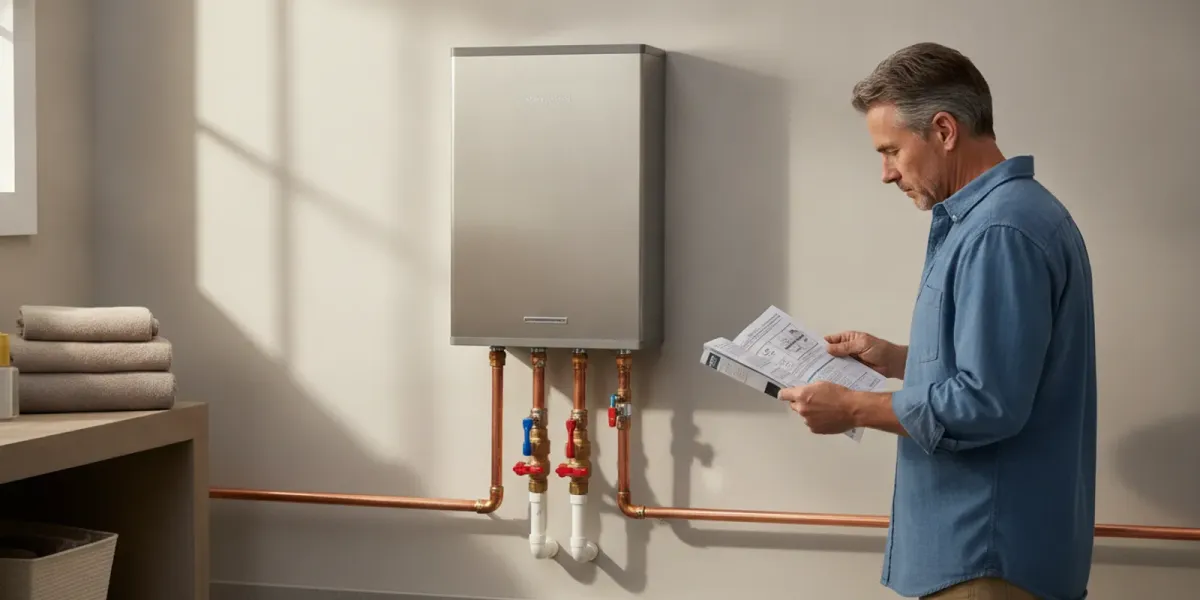
Knowing how to flush a tankless water heater starts with identifying the exact model and reading its maintenance instructions. A flush circulates an approved descaling solution through the heat exchanger to loosen mineral deposits; it is not a universal fix for weak flow or temperature problems. Follow the manual for your appliance, and do not begin if you cannot identify the service ports, valves, or safe shutdown procedure.
Call about tankless water-heater service
Why is a tankless water heater flushed?
As water passes through a heater, dissolved minerals may leave deposits on internal surfaces. Buildup can interfere with heat transfer or water flow. Descaling is intended to loosen that material and carry it out of the heat exchanger. How quickly deposits accumulate depends on the water, appliance, and use; a calendar interval that suits one home may not suit another.
A flush is maintenance, not a diagnosis. Reduced hot-water flow, a temperature change, or an alert on the display may justify checking the owner’s manual, but none proves that scale is responsible. A closed or partly closed valve, a clogged inlet screen, a system fault, or another plumbing issue can produce similar symptoms. Repeating a flush without finding the cause may waste time and could expose the equipment to an unsuitable procedure.
For general background about drinking water and water quality, the U.S. Environmental Protection Agency is a useful starting point. General water-quality information does not replace the heater manufacturer’s maintenance directions or determine the condition of a particular home’s water.
What equipment may be needed?
For a model designed for a homeowner-performed flush, instructions may call for a small circulation pump, hoses that fit the service ports, a bucket, and an approved descaling solution. Some manufacturers specify the solution, connection arrangement, or circulation time. Do not assume vinegar or another household product is acceptable. Confirm the approved product and its handling and disposal directions before opening any service connection.
| Item or check | Why it matters | What to confirm |
|---|---|---|
| Model-specific manual | Defines the safe sequence and compatible materials | Match the model number and read all warnings |
| Service valves and ports | Allow the heater to be isolated and solution circulated | Use only connections identified for maintenance |
| Pump and hoses | Move solution through the heat exchanger | Confirm fittings and arrangement match instructions |
| Approved descaler | Loosens deposits when used as directed | Check manufacturer approval and product label |
| Bucket and protective equipment | Contain liquid and reduce exposure to splashes | Follow label precautions; keep children and pets away |
| Clear work area | Reduces trip, spill, and electrical risks | Keep pump connections and power away from water |
Do not substitute tools because they happen to fit. A hose that does not seat correctly can leak or come loose. A pump should be suitable for the prescribed arrangement, and electrical equipment must be kept away from spills. If the manual calls for equipment you do not have, or the connections appear damaged, stop rather than improvising.
How should you prepare before flushing?
Preparation matters as much as circulation. Locate the manual and record the model information from the exterior label, if accessible without removing a cover. Read the full maintenance section, including shutdown, isolation, rinse, restart, and disposal instructions. If you cannot find instructions for the specific unit, ask the manufacturer or a qualified plumber rather than relying on a procedure written for a different model.
- Check that the task is appropriate. Verify that the manual describes a homeowner procedure and that the appliance has the required service ports. Some heaters require a professional or use a different arrangement.
- Plan the work area. Clear a stable space for the bucket and pump. Keep cords and plugs away from water, protect nearby surfaces as appropriate, and keep children and pets away.
- Shut down as specified. Use the manufacturer’s directions to turn off the heater and, if specified, its electrical or fuel supply. Do not guess which breaker or gas control to use. Never work on internal wiring or gas piping as part of routine flushing.
- Allow hot water and components to cool. Hot water can cause burns. Do not open a connection while it may be hot or under pressure.
- Isolate the appliance. Close only the water valves identified in the manual for the flushing procedure. Tankless units and valve kits differ; do not turn an unfamiliar control just because it is near the heater.
- Relieve pressure only as directed. Follow the manual’s prescribed method. Do not loosen a fitting to test whether pressure remains.
- Connect hoses securely. Attach them to designated service ports and position the pump and bucket according to the instructions. If a fitting does not connect readily, stop; do not force or cross-thread it.
Before proceeding, check that the solution, pump, hoses, and connection points are compatible with the manufacturer’s procedure. Read the descaler label. Follow any protective-equipment and handling precautions. Do not mix products or leave chemicals unattended.
What is the general flushing sequence?
The following stages describe a common approach, not a universal procedure. Valve order, which port serves as inlet or return, solution type, circulation duration, and rinsing method vary. If your manual differs from this outline, follow the manual. Do not use these general steps to override an instruction or safety warning for your model.
- Confirm shutdown and isolation. Recheck that the heater is off and the water supply is isolated as directed. Do not proceed if a valve leaks, will not move, or is not clearly identified.
- Set up the circulation loop. Connect pump and hoses to the service ports in the configuration specified by the manufacturer. Keep hose ends secure and position them in the bucket as directed. Do not direct solution into household plumbing unless the instructions explicitly require it.
- Use the prescribed solution. Prepare the approved descaler exactly as its label and the manual state. Do not increase concentration or add another cleaner in an attempt to speed up the job.
- Circulate for the stated time. Start the pump only as directed and remain with the setup. Watch connections and the bucket. Stop the pump if a hose slips, a leak appears, the pump runs dry, liquid spills near electrical equipment, or the setup behaves unexpectedly.
- Stop and dispose of solution properly. Turn off the pump at the appropriate point. Follow the product label and local disposal requirements. Do not pour remaining solution into a drain or through the heater unless the instructions allow that method.
- Rinse as directed. The manufacturer may specify circulating clean water through the heat exchanger or another rinsing step. Follow the specified route and duration; do not improvise a bypass or assume a rinse is unnecessary.
- Disconnect and restore. With the pump off, disconnect hoses and close service ports as instructed. Restore water flow, power, and fuel in the sequence specified by the manual. Never energize or fire the heater before the required water flow and connections have been restored.
- Inspect and verify. Check accessible connections for leaks and follow the manual’s restart and error-check instructions. If an error appears, a leak develops, or the heater does not operate normally, shut it down using the approved method and seek help.
Do not force a stuck valve or fitting. A damaged port, unexpected pressure, persistent leak, or valve that will not close changes the task from routine maintenance to a repair concern. Leave the unit in a safe state only if you can do so using the instructions, and contact a plumber.
How do tankless models differ?
There is no single flushing schedule or sequence that applies to every tankless heater. Manufacturers may specify different ports, valve positions, chemicals, circulation times, rinsing procedures, and restart steps. The recommended maintenance interval may also depend on water conditions, usage, and the model. Do not use a generic interval as a substitute for the schedule in the manual.
Other maintenance may be described separately. An inlet filter or screen, water treatment equipment, condensate drain, venting system, and heat exchanger are not interchangeable components, and cleaning one does not automatically service the others. Do not remove a cover, clean an internal part, or alter venting unless the manual provides an appropriate procedure and you are qualified to perform it.
If the manual is missing, identify the model from the external label and seek matching instructions from the manufacturer. Avoid directions for a similar-looking unit: small differences in valve kits or controls can change the safe procedure. If the label is inaccessible without opening the case, leave that work to a professional. For information about the company’s water-heater installation and repair services, review its service page.
What should you check before deciding a flush is needed?
Start with observations that do not require opening the appliance. Note whether the problem affects one fixture or several, whether hot water changes only at certain times, and whether the display shows an error. Check that accessible hot-water fixtures are behaving consistently, but do not dismantle the heater or bypass a safety control. These details can help a technician distinguish a heater concern from a fixture or plumbing issue.
Next, compare what you observe with the troubleshooting section of the model manual. Follow only steps identified as safe for the owner. If the manual points to service, or the issue remains after a permitted basic check, arrange an assessment rather than repeating maintenance. A symptom log can help: note when the problem began, which fixtures are affected, any displayed code, recent changes to water use, and steps already taken. Record an error before clearing it, if the manual describes a safe way to do so.
These checks help avoid treating every hot-water complaint as scale. A flush can address deposits when the manufacturer’s procedure is appropriate, but it will not correct every control, plumbing, or equipment fault. If the unit makes unusual noises, leaks, shuts down repeatedly, or shows a warning, use the manual’s safety guidance and get qualified assistance.
How can you prepare for a service visit?
If you decide not to flush the unit yourself, you can prepare without disturbing the heater. Write down the model and serial information visible on the exterior, the approximate age if known, and maintenance history. Record the exact symptoms, when they occur, which fixtures are affected, and any error message or code. A photo of the display or exterior connections can document what you observed, provided you do not remove a cover or approach a hot or leaking area.
Tell the plumber whether the unit has been flushed before, what solution was used if known, and whether a valve or fitting leaked or resisted movement. Be clear about steps you did not take as well as steps you did. That information can help avoid repeating an unsuitable procedure. If there is active leaking, gas odor, or an electrical hazard, prioritize the manufacturer’s emergency safety instructions rather than gathering routine information.
Before maintenance begins, ask what the work includes: whether the technician will inspect the unit, follow its manufacturer-specific process, and check operation afterward. Ask how suspected scale or a separate fault will be evaluated. The answer should be based on the actual appliance and its condition, not a promise that descaling will correct every symptom.
When should you stop and call a plumber?
- You cannot identify the exact model, service ports, or isolation valves with confidence.
- The heater lacks the service connections required by its approved procedure, or the manual directs professional maintenance.
- A valve or fitting is stuck, corroded, damaged, or begins leaking.
- You encounter hot water or pressure you cannot safely manage, or a spill puts electrical equipment at risk.
- You smell gas, see damaged wiring, or encounter an electrical fault. Do not continue troubleshooting internal systems.
- The display shows an error you cannot resolve using the manufacturer’s owner instructions.
- The heater remains unreliable after an approved maintenance procedure, or you are unsure how to restart it safely.
A plumber can assess the equipment and explain the next appropriate step. Hardenburgh Plumbing’s contact page provides a way to reach the company; this is a contact route, not a claim of online appointment booking. Do not describe a flush as a guaranteed repair before the cause of the problem is known.
Frequently asked questions
Can I use vinegar to flush any tankless water heater?
Not necessarily. Use only the solution and procedure approved for the exact model. A product allowed for one heater may not be approved for another, so check the manual before connecting a pump.
How often should a tankless water heater be flushed?
Follow the maintenance schedule in the manufacturer’s instructions. The appropriate interval can vary with the unit and water conditions; do not assume one schedule fits every household.
Will flushing fix low hot-water flow?
It may help if deposits are the cause, but low flow has other possible causes. If the issue persists, have the heater and relevant plumbing assessed instead of repeating a flush without diagnosis.
Can I flush a heater that has no service valves?
Do not improvise connections, remove parts, or use household plumbing connections as substitutes. Check the manual and contact a plumber if the unit lacks the service arrangement required for its approved procedure.
What if the heater shows an error after flushing?
Record the error and consult troubleshooting instructions for the exact model. Do not repeatedly reset the heater or bypass a safety feature; seek professional help if the manual does not provide a safe owner action.
Call Hardenburgh Plumbing about your water heater
Careful, model-specific maintenance is safer than following a generic sequence; when instructions, connections, or symptoms are unclear, leave the work to a qualified professional.